

Last updated: April 2026
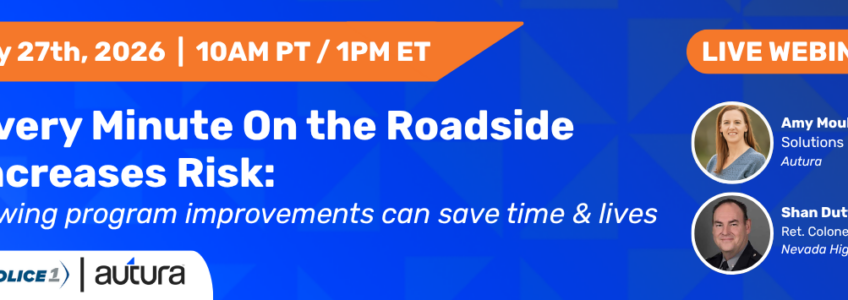
🔎 In this article: Learn why towing-related roadside exposure is an urgent — but also solvable — law enforcement safety challenges. And find out how to join a free Police1 webinar on May 27 featuring real results and specific strategies from agencies that have already made impressive towing program improvement progress.
Traffic stops and roadside incidents play a risky part of nearly every law enforcement shift – and that’s unlikely to change. What can change, though, is how long officers and first responders spend waiting at those scenes.
Chillingly, struck-by incidents remain among the leading causes of law enforcement fatalities. And research clearly shows that the longer an officer is exposed on the roadside, the greater the danger.
The good news? Agencies are finding meaningful, practical ways to reduce that roadside exposure through smart technology investments. Swapping manual processes, siloed tow truck dispatch and tracking, and time-consuming documentation that slowed incident clearance time for integrated towing management software, public safety agencies like Nevada and Utah Highway Patrol have modernized their towing programs and seen swift, life-saving results from this change.
On May 27, join Police1 for a free webinar with Autura Solution Engineer Amy Moulton and Retired Colonel John O’Rourke from Nevada Highway Patrol for an education-focused webinar that digs into exactly this problem: how towing program inefficiencies increase officer risk, and what agencies can do about it today.
Towing Program Performance Numbers Behind Risk
As we prepared to host this webinar, our team brushed up on recent and historical data surrounding roadside danger that law enforcement officers face. Even just a few of the statistics tell a socking story:
- According to the National Law Enforcement Officers Memorial Fund (NLEOMF), there were 34 traffic-related officer fatalities in 2025. While that number decreased compared to the previous year, it remains way too high. In 2024, “struck-by” incidents — where an officer outside their vehicle was hit by passing traffic — jumped 113%, rising from 8 in 2023 to 17 in 2024.
- A landmark 2025 AAA Foundation for Traffic Safety study — analyzing surveillance video of over 12,000 drivers at 169 real-world incident scenes — found that 36% of drivers failed to slow down or move over when passing a roadside incident. When a tow truck was present, compliance dropped even further: only 58% of drivers slowed down or moved over at all.
- In 2024, 46 emergency responders — including law enforcement officers, tow truck operators, firefighters, and EMS personnel — were killed after being struck while working roadside incidents. (Source: Emergency Responder Safety Institute, as cited in AAA Foundation report)
Bottom line? The roadside is a dangerous place. Every unnecessary minute officers, first responders, and tow operators spend there compounds the risk.
Hidden Risk Factor: Towing Workflow Inefficiencies
When public safety agency leaders think about officer safety at the roadside, towing workflows may not be the first thing that comes to mind. But for teams that manage high call volumes with manual or outdated towing processes – especially if dealing with resource constraints like so many agencies are – there’s a valid connection.
When officers must:
- Request tows via radio calls to dispatch – instead of directly
- Wait for confirmation and manually request updates – or go without
- Remain on scene until the tow truck’s arrival and departure
- Document and process incident details via manual or multiple methods
And they must do this all using fragmented, antiquated tools and processes — routine incidents easily stretch to 45 minutes or more of roadside exposure.
Meanwhile, dispatch centers fielding dozens of tow-related radio calls per shift are diverted from higher-priority incidents. And without digital tracking or reporting, there’s no data to surface where the bottlenecks are or how to fix them.
But agencies that have modernized their towing management workflows are seeing a different outcome. Through streamlined digital tow requests, real-time tracking, and automated communications between officers, dispatch, and tow operators, some agencies have cut per-tow roadside time by up to 50% — with measurable reductions in roadside incidents as a result.
Regain Control: Join Police1’s Webinar to Learn How
Police1 and Autura – with guest presenter Retired Col. John O’Rourke from Nevada Highway Patrol – are hosting a free webinar to bring this issue to light. Attendees can look forward to real-world data, practical strategies for measuring towing program performance today, and compelling agency case studies.
📅 Date: Wednesday, May 27, 2026
🕐 Time: 1:00 p.m. ET | 12:00 p.m. CT | 10:00 a.m. PT
💻 Format: Free, live webinar (recording available for registrants who can’t attend live)
You’ll learn:
- National statistics showing how tow-related roadside processes impact safety
- Which manual processes and disconnected systems extend roadside exposure
- How to calculate your agency’s current roadside exposure per tow
- What modern towing management solutions look like in practice — and the results agencies are seeing
This webinar is ideal for:
- Patrol officers and traffic enforcement / highway patrol
- Accident and crash reconstruction investigators
- Motor unit officers
- Emergency communications and dispatch supervisors
- Traffic unit supervisors and public safety communications directors
👉Register now
Can’t Attend Live? Register anyway. Everyone who can’t make the live session will receive a recording. Note that the Q&A portion is only available to live attendees.
Register now on Police1’s website →
Questions about Autura’s towing management solutions for government and public safety agencies? Contact our team to start a conversation.