


Last updated: March 2026
 In this article: Autura partnered with Stripe to commission a study to uncover the truth about towing payment preferences and behaviors of U.S. drivers. Here’s what we learned from 1,000+ responses.
Towing business owners and their teams spend a lot of time solving other people’s problems.
Breakdowns, accidents, weather issues — you step in when something’s already gone wrong. Customers are stressed. Emotions run high. And the faster your team can resolve the situation, the better it is for everyone.
But even when the tow goes smoothly, payment can slow things down, particularly when processes are built around outdated assumptions.
To understand how customers prefer to pay today — and what helps close jobs efficiently — Autura commissioned a national survey of 1,000+ people who recently paid for towing, roadside assistance, or impound services.
Here’s what tow operators should know.
Payment Security is a Top Concern
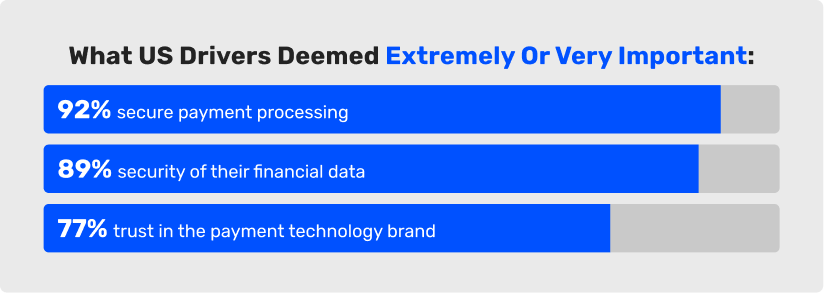
According to the study, customers place a high priority on payment security when paying for towing, roadside assistance, or impound services:
- 92% say secure payment processing is extremely or very important
- 89% say the security of their financial data is extremely or very important
- 77% say trust in the payment technology brand is extremely or very important
But despite how important security is to customers, many lack confidence in the current payment experience:
- Only 37% say their most recent payment felt secure and trustworthy
- 22% say stronger security and trust in payment processing would improve the experience
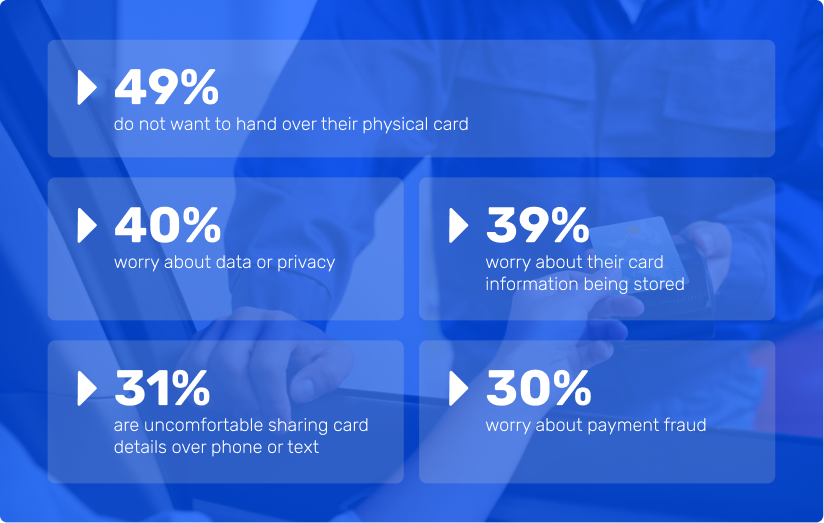
Their doubt shows up in specific concerns at the point of payment:
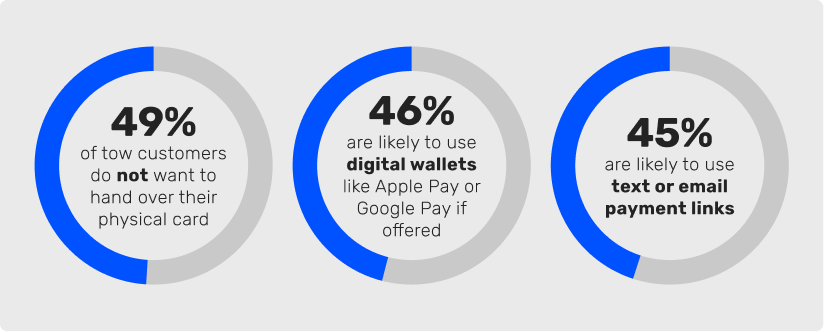
- 49% do not want to hand over their physical card
- 40% worry about data or privacy
- 39% worry about their card information being stored
- 31% are uncomfortable sharing card details over phone or text
- 30% worry about payment fraud
📝Takeaway:
Towing and roadside payments often happen in unpredictable, unfamiliar settings — like the side of a highway at 3 a.m. — where there’s no counter, cashier, or checkout screen to make the payment feel trustworthy. In these situations, customers have fewer cues that a payment is legitimate, so professionalism is critical.
When 77% of respondents say trust in the payment technology brand is extremely or very important (and 30% worry about payment fraud), it’s clear that customers want reassurance, such as:
- Payment experiences backed by well-known, trusted technology
- Options that let customers pay without handing over a card or sharing verbal details
Providing these options will help customers feel comfortable completing payment while reducing hesitation, disputes, and chargebacks for operators.

Speed, Simplicity, and Proof are Essential
Security establishes trust — but it’s not the end of the experience. After a breakdown, accident, or long wait, customers want payment to be fast, simple, and final, so they can leave knowing everything is settled.
- 85% say simplicity (i.e. fewest steps to complete) is extremely or very important
- 81% say convenience (i.e. not needing cash) is extremely or very important
- 76% say transaction speed is extremely or very important
- 61% say receiving an instant digital receipt is extremely or very important
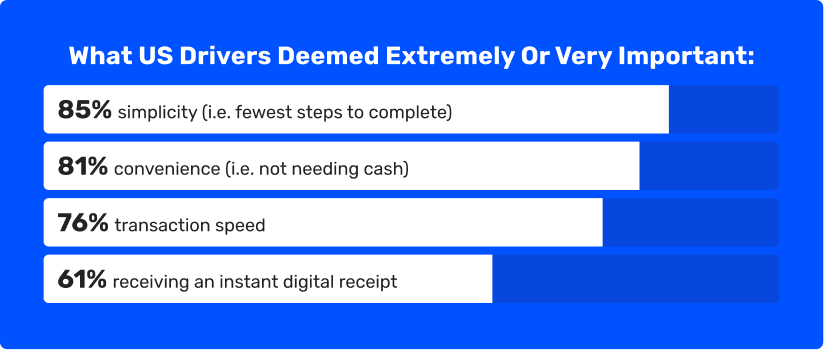
These responses show customers value quick resolution and clear confirmation. Yet many say current experiences fall short:
- 20% want the payment process to be faster or more convenient
- 22% want clearer, easier-to-understand invoices
- 18% say paying at the time of service would improve the experience — indicating that payment couldn’t be completed on-site
📝Takeaway:
When nearly one in five customers encounters friction at the final payment step — slow transaction, unclear charges, or delayed close-out — inefficiencies add up quickly across daily jobs.
Build a simple, fast payment flow and pair it with an immediate confirmation (i.e. text message, email, or physical receipt). For the customer, this eliminates doubt and reduces worry. And for you, this helps close out jobs faster and keeps your team focused on the next call.
Modern Tow Payments Require Mobile Options
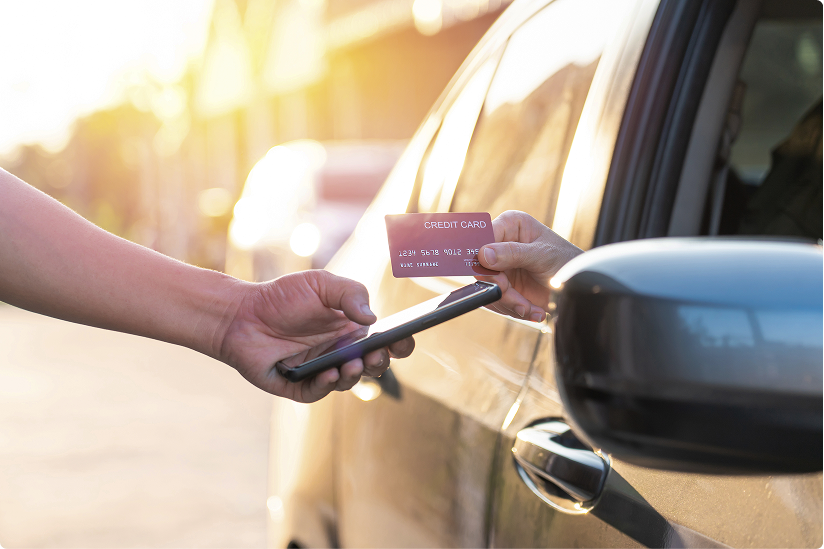
The study results made one thing crystal clear: credit and debit cards remain the foundation of towing payments. Sixty-one percent of drivers name either a credit or debit card as their #1 preferred payment method. However, cards alone no longer meet expectations — especially when nearly half of customers (49%) say they don’t want to hand over a physical card.
Why is this? In some cases, customers may not have a physical card at all. Recent consumer surveys from 2024 and 2025 show that 1 in 5 digital-wallet users regularly leave home without a physical wallet, relying entirely on their phone or smartwatch for payments. ¹ ²
That reality makes mobile payment options increasingly important in unplanned towing and roadside situations — and it aligns with clear customer interest in phone-based ways to pay:
- 46% of customers say they would be likely to use digital wallets like Apple Pay or Google Pay
- 45% say they would be likely to use text or email payment links, citing benefits of convenience and speed (64%) and the security of not having to hand over a physical card (59%).
📝Takeaway:
Customers don’t always have their wallet — but they do have their phone. With mobile-first payments becoming more common, tow operators should treat them as core infrastructure. Digital wallets and text-to-pay reduce friction, prevent stalled payments, and keep jobs moving.
Payment Flexibility Matters, Especially When Costs are High
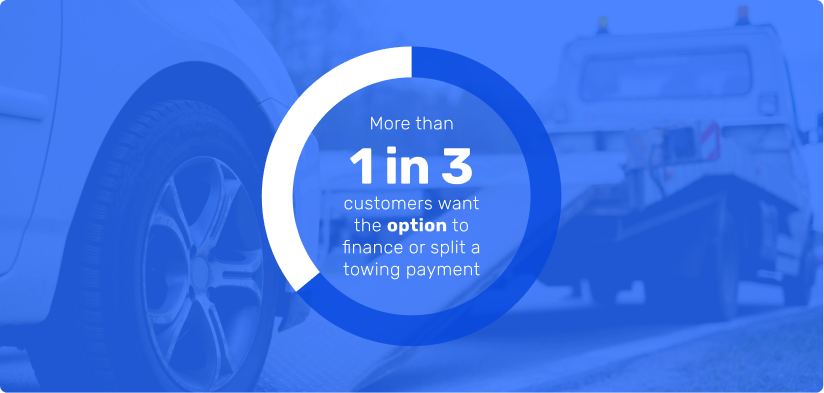
In towing and roadside situations, the challenge isn’t just how customers pay — it’s whether they can proceed at all. More than 1 in 3 (36%) say the ability to finance or split a payment for an unplanned service like towing service is extremely or very important.
And unexpected bills, especially higher ones, can introduce hesitation at the point of service. Payment flexibility helps remove that barrier without delaying resolution. For an unplanned tow bill over $400, 42% of customers say they would be more likely to proceed with service if a Buy Now, Pay Later option were available.
📝Takeaway:
Flexible payments help customers handle unexpected costs without delaying payment. Offer Buy Now, Pay Later to help more customers say yes — while you get paid upfront with no added risk or follow-up billing.
Millennial and Gen Z Customers Reinforce These Trends
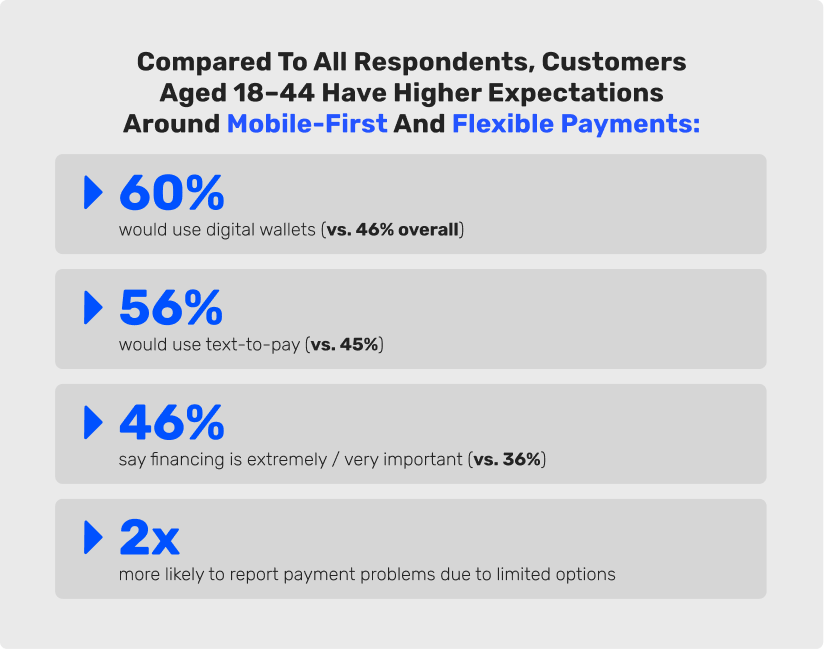
Customers aged 18 – 44 show consistently higher expectations for mobile-first and flexible payment options, signaling where tow payment expectations are headed.
Compared with all respondents:
- 60% would use digital wallets if offered (vs. 46%)
- 56% would use text-to-pay (vs. 45%)
- 46% say financing or splitting payments is extremely or very important (vs. 36%)
- 51% would consider BNPL for an unexpected tow over $400 (vs. 42%)
They are also more sensitive to limited choice:
- 2x more likely to report a payment problem because no payment options were available that they wanted to use
📝Takeaway:
As younger generations make up a growing share of towing demand, modern payment options — digital wallets, text-to-pay, and financing — will become the baseline, not the exception.
Future-proof your payment experience to support customer satisfaction and efficient job completion.

The Bottom Line: Payments Should Help Close the Job
Towing and roadside payments often happen late at night, in bad weather, on the side of the road — when customers are already stressed and just want the situation resolved. In those moments, the right payment tools aren’t just convenient; they’re what keep morale up and keep jobs moving.
This research shows what customers expect at the point of payment: clear trust signals, a fast and simple process, proof that payment is complete, and flexible ways to pay — often from their phone. When any of those are missing, frustration builds and small issues quickly turn into extra admin.
How TowPay by Autura Can Help
TowPay is Autura’s payment solution, built specifically for towing and roadside operations. Its strength stems from the built-in security and fraud protection provided by Stripe, a globally trusted payments platform.
With TowPay, operators can:
- Offer modern payment options at the time of service, including credit cards, text-to-pay, digital wallets, and Buy Now, Pay Later — so customers can pay in the way that feels most comfortable
- Send professional, secure invoices and link-to-pay requests by text or email, giving customers a fast, card-less way to pay with clear confirmation
- Reduce errors, unpaid invoices, and follow-up work, with faster payment, clearer records, and built-in proof that jobs are fully resolved.
When you make it easy for customers to pay the way they want — securely, quickly, and on their terms — jobs get finished without friction, follow-up, or frustration.
Learn how TowPay, powered by Stripe, can help you get paid faster.