


Last updated: December 2025
🔎 In this article: Learn about 5 common towing program challenges that public agencies face with old-school methods for tow requests, dispatching, tracking, and impound management. See the impacts these challenges can have on safety, human resource allocation, and the ability to optimize and innovate.
Across the United States, public safety, municipal, and government agencies are tasked with one of the most vital responsibilities — keeping our communities safe. With this important mission, it logically follows that these agencies should be equipped with the best, most advanced technology. Yet sadly, this is not the case. In fact:
- Nearly a third of all government agencies, including state and local, still rely on legacy systems over a decade old.
- Almost 70% of government agencies name antiquated infrastructure as a top hurdle for modernization, according to a recent EY survey.
- Over 50% of municipal agencies still use manual methods in daily operations.
Other Problems Outdated Towing Management Practices Cause
Above are just a few safety statistics. Beyond the danger they pose to law enforcement and first responders, outdated systems and practices are:
- 💲Costly: they divert funds that could otherwise be used for citizen service improvement or safety initiatives.
- ⛔Inefficient: they require heavy human resources and dependence on subject matter experts to maintain fragile workarounds and integrations across siloed systems and disjointed processes.
- ✖️Untraceable: they leave departments unable to analyze towing program performance, clearly communicate with tow providers, negotiate service contracts based on accurate data, and more.
- ⛏️Rigid and Unscalable: they force reliance on legacy systems, making it near-impossible to adopt and leverage new technologies, such as holistic towing management software (TMS) or AI applications. In fact, that same EY study found that 67% of government leaders say their IT infrastructure isn’t built to handle emerging technologies.
5 Common Towing Program Challenges That Public Safety Agencies Face
For decades, Autura has been partnering with public safety agencies to modernize towing dispatch and tracking, reporting, and impound management. Today we’re sharing some of the most common towing program challenges we typically encounter.
1. Lack of Towing Lifecycle Visibility
Public safety towing programs involve many stakeholders. Information must be accurately shared across police officers and troopers in the field, DOT workers, tow companies (dispatch and tow truck operators), Emergency Communication Centers (ECCs), and citizens.
Antiquated, siloed systems of record and communication methods mean there is no holistic way for stakeholders to stay informed about tow truck requests, acceptance, status, location, destination, and safety.
2. Lengthy Towing Response Times
When first responder law enforcement officers cannot directly, quickly submit requests for tow truck assistance, or must follow manual, multi-step processes to do so, it puts lives at risk. Their own, and the lives of citizens on-scene, too.
The longer anyone spends on roadsides at the scene of an incident waiting for a tow — sometimes referred to as the “kill zone” — the greater the risk of a secondary crash, serious injury, or fatality.
ℹ️ What Is A Kill Zone? In the context of traffic safety, a “kill zone” is the high-risk area where a driver, public safety officer, tow truck operator, or roadside assistance crew member is vulnerable to a collision.
A recent AAA study revealed that:
- 1 in 3 drivers ignore “Slow Down, Move Over” rules, with deadly results.
- Last year, 46 emergency responders lost their lives at roadsides, including law enforcement officers, tow truck operators, and safety service patrol workers.
- The National Highway Traffic Safety Administration (NHTSA) reports that approximately 350 motorists are killed each year after being struck while outside disabled vehicles. Other studies estimate that number is even higher.
3. No Way to Track Tow Truck Activity
When law enforcement must request tows via calls into busy dispatch centers, agencies lose traceability. Telecommunicators must answer, capture details, and contact tow company dispatchers. Those dispatchers then must find, assign, and send an appropriate, available tow truck operator.
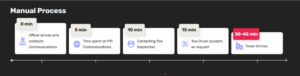
With this fragmented workflow, measurable data about efficiency, performance, and improvement opportunities are simply unavailable. This leaves stakeholders guessing about how to streamline operations and improve towing program safety and efficiency.
4. Heavy Reliance on Dispatch Communications
With law enforcement officers forced to radio ECCs for everything from initial tow requests to updates on tow truck status and location, emergency telecommunicators lose valuable time they could be spending on high-priority incidents.
Instead of focusing on critical citizen and law enforcement activities, dispatch communications teams must handle thousands of inbound and outbound tow-related calls and requests.
Related: Read how Nevada Highway Patrol reduced radio traffic and dispatch calls by 90% with Altura’s towing software suite purpose-built for Government.
5. Time-Consuming, Inaccurate Documentation
Manual processes, phone logs, handwritten notes, and files that require reconciliation mean accurate record-keeping and reporting is near-impossible.
Public safety agencies with outdated towing programs must spend excessive hours on towing-related activity tracking to understand program performance. Inability to do so efficiently makes program improvement and tow provider contract negotiations difficult.
Conclusion
Public safety agencies that embrace modern TMS solutions can solve these and other common towing program challenges. By connecting stakeholders across the towing lifecycle — from incident and roadside clearance, to towing service and through impound — state and local governments can experience improvements in:
- First responder roadside safety
- Faster towing response times
- Time and effort savings across dispatch, tracking, and impound processes
- Strengthened communications and trust with tow providers and citizens
Learn how Autura’s towing software suite purpose-built for can help your agency modernize operations.
📆 Schedule an initial conversation with our team today.