

Last updated: March 2026
🔎In this series: First-time vehicle flippers, small dealers, and DIY enthusiasts can follow Part 1 of 2 in our step-by-step guide for flipping or reselling a vehicle, with advice from where to source to how to sell.
If you’re thinking about flipping your first car but aren’t quite sure where to start, this post is a great place to start.
In this guide, we walk you step‑by‑step through the entire process — from understanding a car’s true value, to estimating repairs, navigating impound auctions where you can source great vehicles for your project, checking for title or recall issues, and finally selling for a profit.
Whether you’re testing the waters or planning to flip more vehicles down the road (🚩if this sounds like you, you’ll need to familiarize yourself with state-level limits and dealer licensing policies), follow this framework to avoid common pitfalls, make smart decisions, and confidently complete your first profitable flip. Read on for part 1 of 2 in this guide.
Step 1: Start with a Game Plan (and an Exit Price)
Before you even touch a wrench 🔧or place a bid 🎫 on a fix-and-flip you’re eyeing, it’s best to define your target buyer and set a comfortable exit price and rough timeline.
ℹ️ What’s an Exit Price? In car flipping, exit price is the final sale price (or projected resale value), or the amount of money you, the flipper, receives when selling the vehicle. For your project to make sense, exit price should be significantly higher than the entry price – or the price you paid for the vehicle plus the cost of repairs you put into it. This ensures you make a profit.
Here’s what that might look like:
- Use‑case: Are you flipping a vehicle for use as a daily driver? To someone for parts? As a project car for hobbyists?
- Price band: Most first‑time flips do best in the sub‑$7,500 bracket where modest repairs can still yield meaningful margin.
- Timeline: Is your goal to turn inventory in 30 days, or are you restoring to “showroom” quality, requiring months of work?
With these elements in mind, take the next steps:
- 1️⃣Set your market value baseline: Pull current values using a trusted guide such as Kelley Blue Book (KBB) to estimate fair purchase and private‑party ranges for the specifics (year, make, model, trim, etc.) and condition.
- 2️⃣Look at local comps: Research similar vehicles selling around you, noting prices that reflect condition, after-market work, etc.
- 3️⃣Gather auction comps: If you’re buying from impound auctions, review historic sold prices and condition notes across listings to help you set a realistic max bid. 💡Autura Marketplace makes this easier with detailed listings requiring sellers to share specific images and condition reports for every vehicle sold.
💾SAVE THIS FORMULA ➡️ Target Sale Price – (All‑In Costs) ≥ Target Profit
All‑in costs = Hammer Price + Buyer/Platform Fees + Transport + Repairs/Parts + Title/Registration/Taxes + Reconditioning.
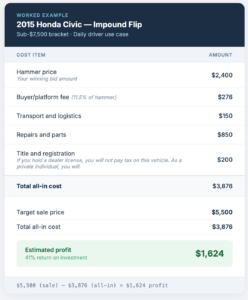
See Step 3 for help on how to set your repair budget.
Step 2: Start Your Vehicle Search at an Impound Auction
Unclaimed vehicle — also known as impound — auctions offer a wide spectrum of inventory, from scrap and parts cars to clean‑title daily drivers. Often, prices are below retail because sellers need to move inventory and free lot space.
With trusted online impound auction platforms like Autura Marketplace, buying has become more transparent and convenient, with verified bidders, consistent photos, and disclosed fees.
And, while impound auctions are a great place to start your vehicle search, they’re not the only place. You can explore other channels for good deals, such as private-party listings and local classifieds.
Related reading and activity:
- Impound Auction Purchasing: A Buyer’s Guide
- 3 Common Impound Auction Expectations vs. Realities
- Explore inventory on Autura Marketplace ⏩Navigate to Buy and search by state
Step 3: Build a Basic Profit Model
Before you place a bid for a impound auction vehicle, consider these cost buckets:
- Auction-related, including —
- Hammer price: your highest bid
- Buyer or platform fee: know it up front.
💡 Autura discloses a single platform fee before you bid — no surprise add‑ons.
- Transport and logistics — what it will cost to tow/haul from the impound lot. Remember, too, that your time has a value.
- Insurance — taking into account transport coverage and liability while the vehicle is in your possession.
- Storage costs — factor in where the vehicle will sit before and after repair. Some impound lots charge daily storage fees until pickup. If you don’t have a private driveway or garage, you may need to budget for short‑term parking or rented workspace.
- Repairs and parts — determine this by:
- Using an independent estimator such as RepairPal or KBB, to get a range. Results will vary, but this will give you a good idea.
💡 Recent consumer data pegs the average repair around the $800–$850 range — but high‑ticket items (e.g., transmissions) can blow a budget; plan contingencies.
- Using an independent estimator such as RepairPal or KBB, to get a range. Results will vary, but this will give you a good idea.
- Title, registration, taxes, and compliance, including —
- Title status: this dictates your path to registration. You must review documentation on each vehicle listing (e.g. clean title, lien sale packet). For national title/brand checks, use the National Motor Vehicle Title Information System (NMVTIS) via DOJ‑approved providers.
ℹ️What is a lien sale packet? It’s the set of documents an impound lot or towing company provides to a buyer when a vehicle is sold after going unclaimed. It contains what the buyer needs to apply for the vehicle title in their state.
- Emissions/Smog: states have different requirements. For example, in California, sellers generally must provide a recent smog certificate and meet program rules/exemptions.
- Open safety recalls: run vehicle VINs through NHTSA’s recall lookup (free).
- Title status: this dictates your path to registration. You must review documentation on each vehicle listing (e.g. clean title, lien sale packet). For national title/brand checks, use the National Motor Vehicle Title Information System (NMVTIS) via DOJ‑approved providers.
Step 4: Follow this Inspection Checklist to Prep for Smart Bidding
Even “as‑is” cars can be profitable — if you assess them well. Use listing photos, condition reports, and any preview windows to look for:
- Title status: Clean, salvage, or lien sale packet. Familiarize yourself with what your DMV will accept.
- Engine/transmission basics: Look for visible leaks, check coolant/oil condition, and note obvious damage.
- Frame/rust: Examine underbody photos, panel gaps, and suspension mounts.
- Airbags and safety: Review light indicators and run that NHTSA recall check.
- Emissions equipment (where applicable): 🚩Red flag is there are signs of tampering!
- Keys and starts/runs status: “Runs & drives,” “starts,” or “does not run” materially affects transport and repair costs
💡Autura listings will always label this clearly, but other auction platforms may not be so transparent).
✨Pro tip: Cross‑verify the VIN against NMVTIS for brands (e.g., flood, salvage) and theft flags before you commit.
Conclusion — Part 1
Great news! You’re in excellent shape heading into the next part of your flip or vehicle resale journey. In part 2 of this guide (coming soon!) we’ll cover:
- Bidding tactics that protect your margin
- What to do after you place the winning big (congrats!)
- Legal and licensing advice
- Reconditioning within budget
- Resale strategies
- A final quick-start checklist